
Author: Dan

  • What It Actually Took to Finish Paul’s Penance

    What It Actually Took to Finish Paul’s Penance

    Twenty-two years ago, I started writing a book called Paul’s Penance.

    Somewhere along the way, it became Reset Button. Then it became Paul’s Penance again. I have the folders to prove it: Draft 1, Rev 1, Rev 2, Rough Draft 1.0, Reset Button 4.0, Reset Button 5.0, and finally, just “Working,” like the file itself got tired of pretending it knew what it was called. Two titles trading places for over two decades, each one feeling like the right name at the time.

    I used to think that was the story: a guy who couldn’t make up his mind, circling the same manuscript for twenty-two years because something in it wasn’t working yet.

    I don’t think that’s the story anymore.

    Here’s what actually happened. I had to finish Alignment Before Outcome first. I had to get through cancer. I had to keep showing up for morning pages, day after day, long before I understood what any of that daily, unglamorous practice was actually for. None of those things were Paul’s Penance. All of them were, apparently, prerequisites for it.

    I don’t think I could have finished this book without finishing those other things first. Not because they taught me craft, though they did some of that, but because Paul’s Penance is a book about a man who’s given thirty days to face what he owes, and to whom. I couldn’t write my way to the end of that question from the outside. I had to actually go live some version of it. Cancer has a way of asking you what you owe and to whom in a tone that doesn’t accept a deflection. Morning pages have a way of making you sit with an unfinished thought until it finishes itself, whether you wanted it to or not.

    So the book waited. It changed its name twice while it waited. And it turns out that was never wasted time. It was the book refusing to be finished by a version of me that wasn’t ready to finish it honestly yet.

    I’m back to calling it Paul’s Penance now, and I don’t think that title is going to move again. I’m deep in revision, chapter by chapter, catching the places where the story still contradicts itself. And a few of those contradictions, it turns out, are the interesting ones. I’m finishing it at the pace it needs, not the pace a calendar wants.

    Twenty-two years is a long time to spend on one book. I used to be a little embarrassed by that number. I’m not anymore. It took exactly as long as it took to become someone who could actually finish it. I don’t think that’s a flaw in the process. I think that’s just what a book this personal costs.

    More updates soon. There’s a bigger one coming next week.

    If this resonated, pull up a chair. I send one letter a month with new writing and honest updates on my novel, Paul’s Penance. Sign up at danhansen.com.


  • Letting It Fall, Then Sorting It Clean

    Letting It Fall, Then Sorting It Clean

    There’s a version of surrender that sounds like letting go of everything.

    “Throw it up in the air and let God sort it out.”

    There’s truth in that. It points to trust. To releasing the need to control every outcome or prearrange every answer.

    But there’s another layer that becomes clear with time.

    Letting go doesn’t mean checking out.

    It doesn’t mean avoiding what’s in front of you or refusing to engage with what’s unfolding.

    It means releasing control while staying present.

    For me, that looks like writing things down instead of tossing them aside. Looking at what’s there instead of ignoring it. Sorting what falls, placing each thought where it belongs, not to force meaning, but to understand what’s already emerging.

    There’s a quiet distinction here that changes everything.

    Surrender allows life to move.

    Avoidance steps out of it.

    Both can look similar from the outside. Both can sound like letting go. But internally, they come from very different places.

    One is trust.
    The other is disengagement.

    What I’ve found is that real alignment sits between the two.
    Not controlling.
    Not abandoning.

    Participating.
    Trust what’s unfolding.
    And still show up with the pen in your hand.

    Alignment Before Outcome

    You don’t have to control the story to be responsible for how you show up inside it.

    Alignment isn’t passive.

    It’s participation without force.

    Surrender writes the story, but participation is how you hold the pen.

  • The Shift Happens in Small Moments

    The Shift Happens in Small Moments

    Transformation doesn’t always arrive with a clear signal.
    Most of the time, it shows up quietly.

    In how you respond when something doesn’t go as planned.
    In whether you escalate or move on.
    In how tightly you grip when something doesn’t work right away.
    This day wasn’t marked by big wins.

    It was marked by small choices.
    Choosing not to react.
    Choosing to stay present.
    Choosing to adjust instead of forcing things into place.
    Those choices don’t feel significant in the moment.
    But they compound.

    They create a different experience of the same situations.
    Where there used to be tension, there’s space.
    Where there used to be control, there’s participation.
    Even something as simple as learning to crochet becomes a reflection of that shift.

    You can’t force the stitches.
    You have to feel them.
    Adjust.
    Try again.
    That’s the work.

    Not perfection.
    Not immediate success.
    Just staying with it long enough for it to become natural.

    Alignment Before Outcome

    Alignment isn’t proven in big moments.

    It’s revealed in how you handle the small ones.


    You know you’ve changed when the moments that used to trigger you now simply pass through you.


    If this resonated, pull up a chair. I send one letter a month with new writing and honest updates on my novel, Paul’s Penance. Sign up at danhansen.com.

  • Why Life Sometimes Follows Story Structure

    Why Life Sometimes Follows Story Structure

    Years ago, during marriage counseling, I was given an unusual assignment.

    Instead of a worksheet or communication exercise, the therapist suggested something unexpected: learn screenwriting.

    At the time the idea felt strange. I wasn’t trying to become a filmmaker. I was just trying to understand why my life felt unstable and confusing.
    Still, I followed the suggestion and began studying story structure.

    Screenwriters analyze stories using concepts like catalysts, turning points, rising tension, and the emotional arc of a character moving through difficulty toward transformation.
    Stories, it turns out, follow patterns.

    There is usually an ordinary world where life feels predictable. Then something disrupts that stability. The character resists the disruption, struggles through uncertainty, and eventually reaches a moment where something inside them must change.
    Only after that internal shift can the story move forward.

    Years later, when I began journaling during a period of illness and uncertainty, I wasn’t thinking about storytelling at all. I was simply trying to stay mentally clear while navigating a difficult season of life.
    But as I reviewed those journal entries later, something fascinating appeared.
    Many of the moments I had written about matched the same structural beats screenwriters use when mapping character transformation.

    There were catalysts, internal debates, dark nights of the soul, and small breakthroughs in understanding.

    Without realizing it, I had been documenting my life like a story.

    The structure had been there all along.

    Alignment Before Outcome
    Alignment often begins with understanding the narrative we are living inside.

    When difficult experiences appear random or chaotic, they can feel overwhelming. But recognizing patterns within those experiences can restore clarity and direction.

    Story structure becomes a way of making sense of transformation.


    The structure of the story had been there all along.


    If this resonated, pull up a chair. I send one letter a month with new writing and honest updates on my novel, Paul’s Penance. Sign up at danhansen.com.

  • Progress With Friction Is Still Progress

    Progress With Friction Is Still Progress

    Growth rarely feels clean.

    Even in a good week, there are layers.
    Progress and doubt.
    Momentum and fatigue.
    Confidence and physical limits.
    All showing up at the same time.

    It is easy to look at what is not working.
    The body not fully cooperating.
    The moments where support feels absent.
    The reminders that you are still in the middle of something, not at the end.
    But those things do not cancel the progress.
    They exist alongside it.

    Thirty seven thousand words is not theoretical.
    It is evidence.
    Showing up daily is not an idea.
    It is practice.

    The key shift is learning how to hold both.
    To acknowledge what feels off without losing sight of what is moving forward.
    There is also something important in the way decisions are being made now.

    Not waiting until things get worse.
    Not ignoring signals.
    Responding earlier.
    Taking care of what needs attention before it becomes a problem.
    That is alignment in action.
    Not dramatic.
    But real.

    Alignment Before Outcome

    Alignment is not about removing friction.

    It is about continuing forward while responding to what needs care.


    You are allowed to move forward and take care of yourself at the same time.


    If this resonated, pull up a chair. I send one letter a month with new writing and honest updates on my novel, Paul’s Penance. Sign up at danhansen.com.

  • Paul’s Penance: A First Look

    Paul’s Penance: A First Look

    For a long time, I’ve kept this one close.

    Now it’s time to introduce it.

    He stole flowers. The court gave him a choice: go to jail or write a book.

    That’s where Paul’s story begins.

    Thirty days to find his story. A lifetime to find himself.

    Paul’s Penance is a novel about what happens when life refuses to follow the plan, and a man is forced to sit down and look at the story he’s been living.

    Somewhere in those thirty days is a question about his father that he has never been able to answer.

    I’m in the final stretch of revisions now, with the goal of submitting it to Hay House this December.

    I won’t be sharing pages from the manuscript here. But I will share the journey: what I’m learning, what’s working, and what it takes to finish a book.

    If you’d like to follow along, pull up a chair. I send one letter a month with honest updates on Paul’s Penance and new writing.

    Sign up at danhansen.com.

  • You Don’t Need to Start Over

    You Don’t Need to Start Over

    Starting over sounds appealing.

    Clean slate. New identity. A chance to leave everything behind and begin again without the weight of what came before.

    But most of the time, that instinct isn’t about growth.
    It’s about escape.

    We think the past needs to be erased for the future to matter. That our mistakes disqualify us from moving forward as we are.
    They don’t.

    Every experience, even the ones we wish had gone differently, contributed to who we are now. Not as justification. As formation.

    The real shift happens when you stop trying to become someone new and start recognizing who you’ve already become.
    Especially in the moments that mattered most.

    Staying when things were hard.
    Showing up when it would have been easier to disappear.
    Continuing to move forward without certainty.
    Those are the moments that define you.

    Not the ones you regret.
    Regret doesn’t teach.
    It weighs.

    And at some point, you have to decide to put it down.
    Not because everything was perfect.
    Because carrying it no longer serves you.

    What matters now isn’t rewriting the past.

    It’s continuing forward without needing to prove anything about it.

    Alignment Before Outcome

    You don’t move forward by becoming someone new.

    You move forward by staying present as the person you’ve already grown into.


    You don’t need a new beginning when you finally stop leaving yourself.


    If this resonated, pull up a chair. I send one letter a month with new writing and honest updates on my novel, Paul’s Penance. Sign up at danhansen.com.

  • Welcome Back

    Welcome Back

    On July 27, I opened a fresh composition book.

    The three notebooks before it held Morning Pages from February through June. Together, they carried me toward radioactive iodine treatment and then stopped.

    Now the treatment was behind me.

    My body wasn’t finished with it, but I had made it through.

    The first words on the new page were simple.

    Welcome back.

    Then Bob began.

    He greeted me, congratulated me for making it through the treatment, and acknowledged that some of what I had written beforehand had caused me pain.

    There was no grand explanation. No demand that I turn the experience into a lesson before I had finished living through it.

    Just a welcome.

    Starting another notebook had felt unnecessary at first. There were still blank pages elsewhere. I could have squeezed the new work into whatever space remained.

    But something in me wanted a clean beginning.

    The new cover reminded me of Star Trek. Sitting there with the notebook open, I began to understand why I had chosen it.

    These were more than Morning Pages.

    They were Pathfinder pages.

    A mission log.

    A record of where I had been, what my body had survived, and whatever waited beyond the part of the map I could already see.

    The thought was becoming dangerously serious, so my imagination did what it often does.

    Pinky and the Brain barged in with an absurd question about frogs.

    I laughed.

    That was when I knew I was really back.

    Not because the treatment was over.

    Not because I felt strong again.

    Not because I understood what any of it meant.

    I was back because the strange little world inside me was still alive.

    Bob was still talking. Cartoon characters were still interrupting. A notebook could still become a starship, and a blank page could still become someplace I hadn’t visited yet.

    Soon, one idea opened into another.

    My body had interrupted the work.

    It had not ended it.

    Near the bottom of the page, the conversation returned to the Pathfinder and the person responsible for guiding it.

    The answer that emerged was simple.

    I was the ship’s compass.

    The treatment had reminded me how little I controlled.

    The notebook reminded me that I still had direction.

    Alignment Before Outcome

    Coming back did not mean returning to who I had been before treatment.

    It meant recognizing what was still alive.

    My strength had not fully returned. My body was still recovering. The map ahead remained unfinished.

    But the next page was open.

    For that morning, direction was enough.


    “My body interrupted the work. It did not end it.”


    If this resonated, pull up a chair. I send one letter a month with new writing and honest updates on my novel, Paul’s Penance. Sign up at danhansen.com.

  • Unconditional

    Unconditional

    One morning, I looked at myself and thought, You really let yourself go.

    I meant it physically, but not only physically. I could see the places where I had stopped participating in my own life. My energy had changed. My attention had drifted. Things I said mattered to me were receiving whatever effort remained after everything else.

    The observation was uncomfortable, but it was honest.

    Accountability mattered. I did not need to punish myself, but I could not pretend my choices had no consequences either.

    That led me back to a word I have wrestled with for most of my life.

    Unconditional.

    I learned early how conditions worked. If I behaved, I was rewarded. If I performed well, I was valued. If I succeeded, I was celebrated.

    Some conditions are necessary. Actions have consequences. Boundaries matter. Trust can be strengthened, damaged, and sometimes lost.

    Unconditional does not mean tolerating everything.

    Somewhere along the way, though, I began attaching conditions to more than behavior. I attached them to my willingness to participate.

    I would give my full effort if I knew it would work.

    I would trust if I knew I would not be disappointed.

    I would begin if someone could guarantee the ending.

    Without realizing it, I had turned certainty into the price of showing up.

    Surrender carried the same problem. I heard the word and imagined defeat. Giving up meant failure, and failure became another judgment about who I was.

    I see it differently now.

    Sometimes giving up means abandoning the effort. Sometimes it means releasing the demand that the effort produce one particular result.

    Those are not the same thing.

    I can show up honestly without knowing what will happen. I can act with integrity and still adjust when something does not work. I can acknowledge a poor result without turning myself into a failure.

    Unconditional effort does not require rigid expectations.

    It asks me to participate without bargaining for a guarantee.

    Alignment Before Outcome

    I used to believe commitment meant holding tightly to the outcome I wanted.

    Now I am learning to hold the effort and the expectation differently.

    The effort can remain wholehearted.

    The expectation can remain flexible.

    That is not passivity. It is participation without making certainty a condition of beginning.


    “Unconditional doesn’t mean passive. It means fully present without bargaining.”


    If this resonated, pull up a chair. I send one letter a month with new writing and honest updates on my novel, Paul’s Penance. Sign up at danhansen.com.

  • What Care Can Hold

    What Care Can Hold

    Before the first appointment of the day, I had a conversation with Jeff about Bear.

    I already knew the truth.

    I couldn’t care for Bear physically or financially. Wanting him wasn’t enough. Taking him in when I couldn’t give him what he needed wouldn’t have been fair to either of us.

    Knowing that didn’t make saying it easier.

    I felt myself getting choked up. My hormones were still unsettled from treatment, and it didn’t take much to bring tears close to the surface. I fought them because there were appointments ahead and things that still needed to be done.

    First came the echocardiogram.

    I got through it, although it left me tired. Then I caught a Lyft to Stroger for the full-body scan following my radioactive iodine treatment.

    The afternoon scan went better than the first one. It took less time, and I didn’t need another radiation pill because enough remained in my body from the treatment.

    By the time I got home around 4:30, I was exhausted.

    Jeff and Bear were outside when the car dropped me off.

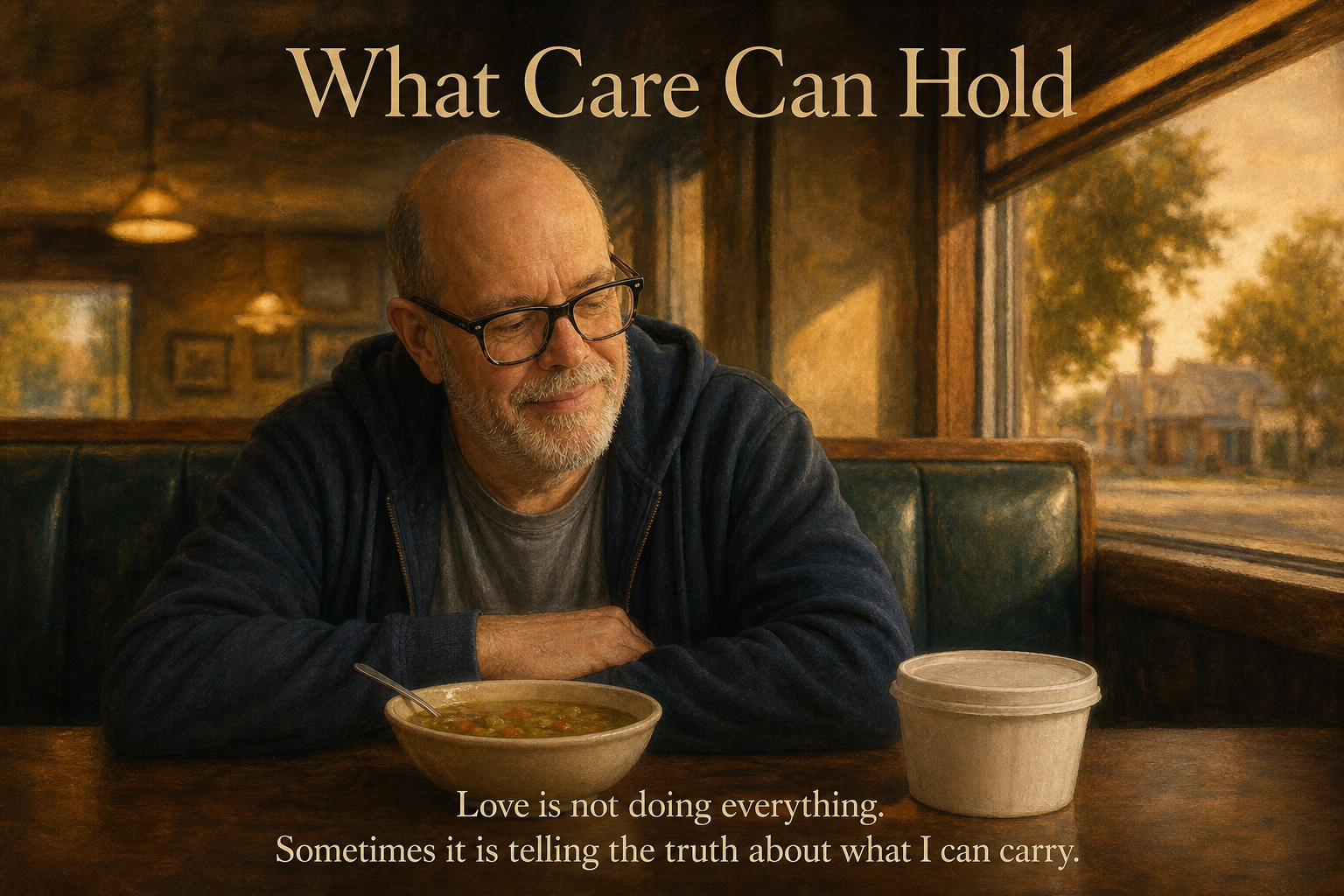
    A little later, Jeff and I went out for split pea soup. I paid. Then I bought the last of the soup to bring home for him.

    It wasn’t a grand gesture. It was soup.

    But it was something I could give.

    That was the quiet truth running beneath the entire day.

    There was care I couldn’t provide, no matter how much I wanted to. There was care I had to receive because my body couldn’t carry the day alone. And there was care I could still offer in return, even if it came in a takeout container filled with split pea soup.

    I used to think love meant doing everything.

    Maybe love is more honest than that.

    Sometimes love means admitting what I cannot carry. Sometimes it means allowing someone else to help me. Sometimes it means noticing one small thing I can do and doing it without treating its size as a measure of its worth.

    I couldn’t solve everything that day.

    I could tell the truth about Bear.

    I could get through the appointments.

    I could buy the soup.

    That was what care could hold.

    Alignment Before Outcome

    Accepting my limits did not mean I cared less.

    It meant I stopped asking love to make promises my body and circumstances could not keep.

    Alignment did not remove the sadness. It helped me respond honestly to it.

    I could not give everything.

    I could give what was mine to give.


    “Love is not doing everything. Sometimes it is telling the truth about what I can carry.”


    If this resonated, pull up a chair. I send one letter a month with new writing and honest updates on my novel, Paul’s Penance. Sign up at danhansen.com.