
Month: November 2026

  • What Plays While I Sleep

    What Plays While I Sleep

    K. M. Weiland chooses music for every stage of her writing.

    In an episode of Helping Writers Become Authors called Learn How to Make the Most of the 5 Stages of the Writing Process, she walks through how her soundtrack changes as the book does. Music by the fire at night when an idea is taking shape. Something with thinking space for outlining. High energy and adrenaline for drafting. Repetitive video-game soundtracks for revising, so her focus stays on the page.

    It caught my ear, because I’m the opposite.

    When I write, there is no music playing. Just me, the coffee, and the pages. Silence is where I hear the story.

    But that doesn’t mean nothing is playing.

    My soundtrack runs at night.

    I fall asleep and wake up to an audiobook, almost always one of two old friends. The Martian by Andy Weir, a man solving one problem at a time so he can live long enough to solve the next one. Or The Iron Druid Chronicles by Kevin Hearne, a two-thousand-year-old druid who never stops learning.

    Lately, the wee hours belong to someone else. I started K. M. Weiland’s podcast from the very beginning. Eighteen years of episodes on story structure, character arcs, and the craft of writing, running through my head while I sleep.

    I can’t tell you exactly how it works. I can tell you what I’ve noticed.

    The ideas show up in the morning. A phrase from an episode surfaces in my Morning Pages. A scene that was stuck finds its real home. A word I didn’t have finally arrives. Some mornings, I’m barely awake before something I heard at 3 a.m. is already reshaping a chapter.

    It has literally turned my writing into better writing.

    She uses music to set the mood for the work. I use the night to fill the well, so that when the silence comes, there’s something there to hear.

    Maybe that’s the real lesson in her episode. Not which music to choose, but that every writer needs a soundtrack. Yours just has to fit the way you work.

    Mine plays while I sleep.

    Alignment Before Outcome

    You don’t have to work the way someone else works.

    You only have to notice what feeds you, and keep showing up for it.

    The work happens in silence. The well fills at night.
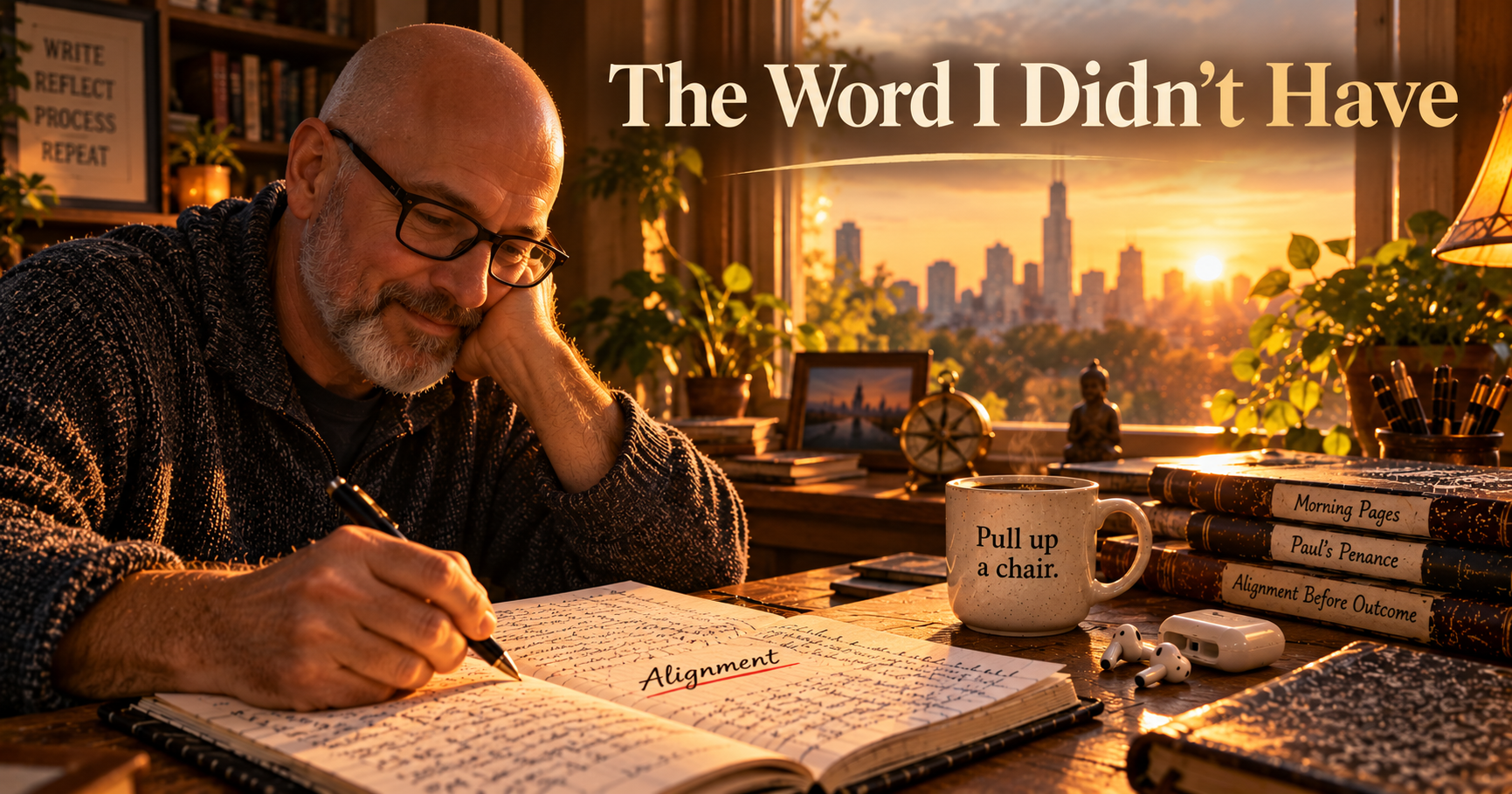
  • The Word I Didn’t Have

    The Word I Didn’t Have

    Three days ago, a submission window opened that I spent most of this fall building toward. I want to tell you honestly where things actually stand, instead of pretending the countdown still means what it used to.

    Here’s the truth. The book isn’t ready for that window, and for about a week that felt like I was failing at something. I had a schedule. I had chapters bucketed into light passes and deep rebuilds. I had a date circled. And the closer I got to it, the more I kept finding real work I hadn’t accounted for, whole stretches of the story that needed to be rebuilt, not polished, discovered later than I wanted to discover them.

    Two things happened almost back to back that changed how I was looking at all of it, and both of them trace back to K. M. Weiland’s podcast Helping Writers Become Authors. One episode, 8 Ways to Troubleshoot a Scene–and 5 Ways Make It Fabulous, helped me see why a scene that had been fighting me for weeks wasn’t broken, it just hadn’t found its real home yet. Another, 4 Ways to Write a Thought-Provoking Mentor Character, days later, handed me language for something I’d already built without naming it, a mentor figure who’d been quietly doing his job the whole time, nudging instead of lecturing, costing something every time he got ignored. Neither episode was about my deadline. Both of them changed how I was thinking about my deadline anyway, because they kept proving the same thing to me from different angles: the story already knows more than I’m giving it credit for. I just have to actually look.

    So here’s the honest update. I’m not racing the clock to hit this window. I’m finishing the book at the pace the hardest chapters actually need, the ones I already know deserve care over speed. I’m bringing in beta readers before anyone outside this process sees it, which is something a hard contest deadline never gave me room to do. And I’m going to self-publish it.

    That last part isn’t a consolation prize. A publisher looking at a self-published book with real readers behind it is looking at something different than a manuscript competing cold in a pile of other people’s first submissions. So the plan now is to finish this right, get it in front of real readers, put it out into the world myself, and keep building an audience while I do it, this post being one small piece of that. Then, when the next window opens in the spring, I walk in with a published book and people who already know it, instead of a deadline I was white-knuckling toward.

    Watching a window open that I’m choosing not to jump through isn’t the failure it would have felt like a week ago. It’s the day the plan got honest instead of just getting faster.

    Thanks for being here for it, and thanks, genuinely, to a podcast that keeps showing up exactly when I need it to.

    Alignment Before Outcome

    You can’t change a pattern you haven’t named.
    Alignment starts with seeing what’s true, even when it shows up in someone else’s story first.

    A pattern you can see is a pattern you can choose differently.

    If this resonated, pull up a chair. I send one letter a month with new writing and honest updates on my novel, Paul’s Penance. Sign up at danhansen.com.

  • No Messy Lines

    No Messy Lines

    Election Day. Thank God I voted early. The best advantage: no messy lines and no campaigners begging for votes.

    Speaking of messy lines.

    I was listening to K. M. Weiland’s podcast, Helping Writers Become Authors, episode 443: Do You Have Sloppy Writing Habits? To me, a sloppy writing habit was simple. It was not coming to the pages.

    But the more I thought about my own sloppy habits, the more I realized they weren’t really about writing. They were about my environment.

    I grew up in my mom’s house, and my mom was a packrat. Touching the chaos could get you punished. Clutter was normal. It was home.

    My brothers and I have accepted it, and all three of us fight the same battle. Thanks to his wife, John at least has organized clutter and keeps his inner packrat in check. Jeff and I are a different story. We even have clumps of Bear’s fur rolling around like tumbleweeds.

    For over sixty years, I couldn’t count how many times I tried to create order. I even hired an organizer. To this day, I clean, and then it piles up again. There is a part of me that still likes being knee deep in clutter.

    Then came cancer.

    A toxic environment doesn’t help at all when you’re fighting for your life. So I fell back on what I had: writing.

    Habit one: Coffee and pages

    The Morning Pages got me writing every day, no matter how crappy I felt or what condition I was in. Coffee and pages, every day since June 1, 2025.

    Over a year later, I still meet my pages, in longhand, in my notebooks and composition books. I’ve never done anything that consistently in my life.

    Thank you, Julia Cameron.

    Habit two: Printing

    When it came time to turn a year of journal entries into my reflective memoir, Alignment Before Outcome, it was pure hell. I tried OCR, and it couldn’t read my writing. I tried typing it myself, which was worse, because some of what I’d written was unrecognizable even to me. No wonder software couldn’t decipher my chicken scratch.

    So I made my life and my computer happy. I started printing my pages instead of writing in cursive. That’s how I got one full year into Scrivener.

    Habit three: Organizing the story

    My third habit was using Scrivener to organize everything. On February 8, 2026, while I was dumping a year of pages into it, I saw a pattern.

    A story. My story.

    With the help of AI, I could work faster: editing, questioning what I’d written, fixing my grammar, and marking my inner voice with asterisks so I knew when it was talking.

    And sometimes, it wasn’t only my inner voice.

    On Father’s Day 2026, while I was in the flow, my Dad showed up on the page. He told me he’d always been watching over me, and that he was proud of my book and what I wrote.

    Dad, this one’s for you.

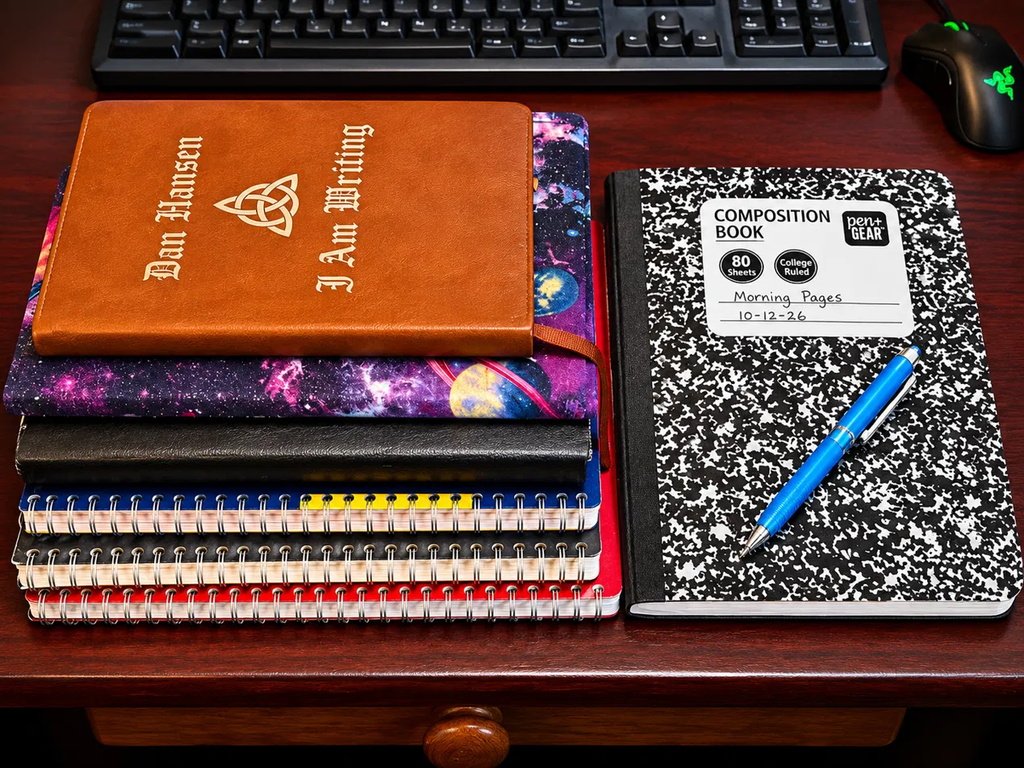
    A stack of journals and spiral notebooks beside a composition book labeled “Morning Pages” with a blue pen, on a cleared wooden desk below a keyboard.
    Every page in these notebooks came out of a messy desk. The desk is cleared now. The notebooks stayed.

    The house is still a work in progress. But the pages? They’re in order. Every one of them, stacked and dated, proof that I kept showing up.

    Alignment Before Outcome

    The clutter didn’t disappear all at once. It never does.

    Order didn’t come from cleaning harder. It came from showing up to the same page, every day, until the page started showing me the way.

    Sloppy habits aren’t about mess. They’re about not showing up.


    If this resonated, pull up a chair. I send one letter a month with new writing and honest updates on my novel, Paul’s Penance. Sign up at danhansen.com.

  • Paul’s Penance: Four Days Out

    Paul’s Penance: Four Days Out


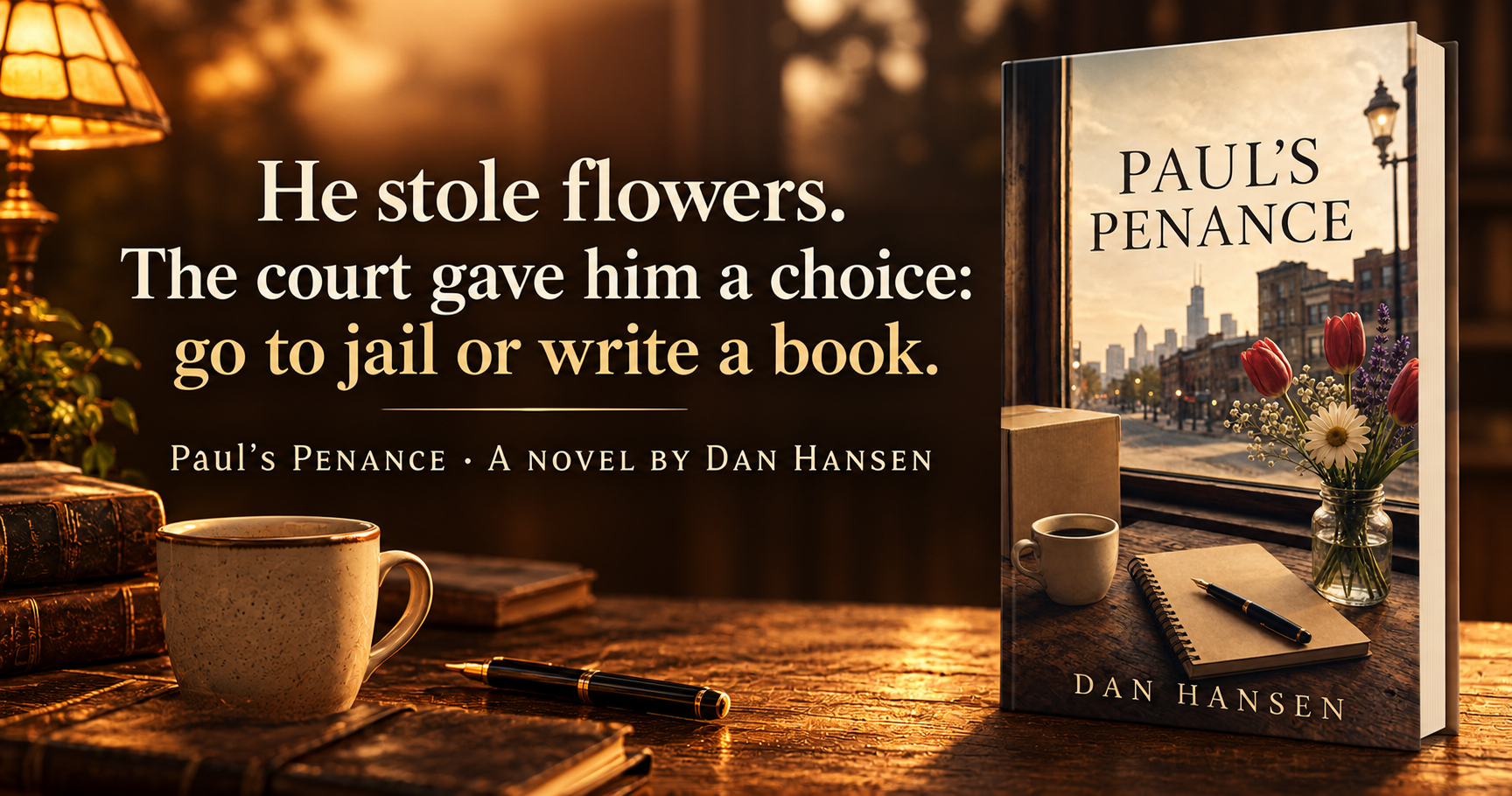
    He stole flowers. The court gave him a choice: go to jail or write a book.

    In four days, the Hay House Writer’s Community contest window opens. Here’s an honest update on my novel, and on why I changed my mind twice in one week.

    What Paul’s Penance is about

    Paul is a man who has run out of second chances. When a judge hands him an unusual sentence, thirty days to write a book or thirty days in county jail, he picks up the pen, thinking it’s the easy way out.

    It isn’t.

    To write the book, Paul has to face the story he’s spent his life avoiding: the choices he made, the people he let down, and the man he could still become. Thirty days to find his story. A lifetime to find himself.

    Paul’s Penance is fiction built on a true life, reshaped enough to breathe on its own. It’s set in the Chicago I know, and it’s about something I believe with my whole heart: it’s never too late to tell the truth, even to yourself.

    Twenty-two years in the making

    I started writing this book in 2004 under the same name, Paul’s Penance. In 2021, during NaNoWriMo, it became Reset Button. This year it came home to its original title, and to the version that finally feels finished.

    Three titles. Twenty-two years. One story that wouldn’t let me go.

    Why I let the deadline go, and why I’m back

    A week ago, I told myself I wasn’t going to make the December window. Some chapters needed rebuilding, not polishing, and I chose finishing the book well over hitting a date. So I let the deadline go.

    And then something happened I didn’t expect.

    With the pressure off, the work got easier. I sat down with the manuscript and saw what it actually needed: one consistent point of view, told in first person, all the way through. Once that change was made, the story settled into place. A few more chapter read-throughs, and Paul’s Penance is ready for readers.

    So I’m going back to my original plan. This window, I’m sending it in.

    What happens next

    If it’s chosen, wonderful. If it isn’t, Paul’s Penance still goes out into the world. I’ll self-publish it, and you’ll be among the first to read it.

    Either way, the book is done being a someday.

    If you’d like to follow along, sign up below. You’ll get updates on Paul’s Penance, new Coffee Couch episodes, and my free guide, Tools I Write With.

    Four days out. Pull up a chair.


    If you’d like to be one of those first readers, pull up a chair. I send one letter a month with honest updates on Paul’s Penance and new writing. Sign up below and you’ll also get my free guide, Tools I Write With.

    Four days out.

    Sign up at danhansen.com.

  • When Things Become Real

    When Things Become Real

    There is a moment when ideas stop being ideas.

    They become something you can step into.

    That shift is subtle, but unmistakable.

    It is not about perfection.

    It is about structure.

    Dan Hansen LLC is a good example.

    For a long time, it existed as a concept. Something I thought about, planned around, and revisited when the timing felt right.

    Then one day, the pieces started coming together.

    A conversation.

    A plan.

    A next step that did not require overthinking.

    That is when it became real.

    The same thing happens in other areas.

    Letting go of roles that no longer fit.

    Reevaluating commitments that once mattered but no longer align.

    Even something as simple as reworking your living space.

    These are not separate actions.

    They are connected.

    They all reflect the same internal shift.

    You are no longer holding onto things out of habit.

    You are choosing what stays based on alignment.

    And just as important, you are allowing things to be incomplete.

    The business plan does not need to be perfect.

    The room does not need to be finished.

    The decision does not need to be rushed.

    It just needs to be moving.

    That is what makes it real.

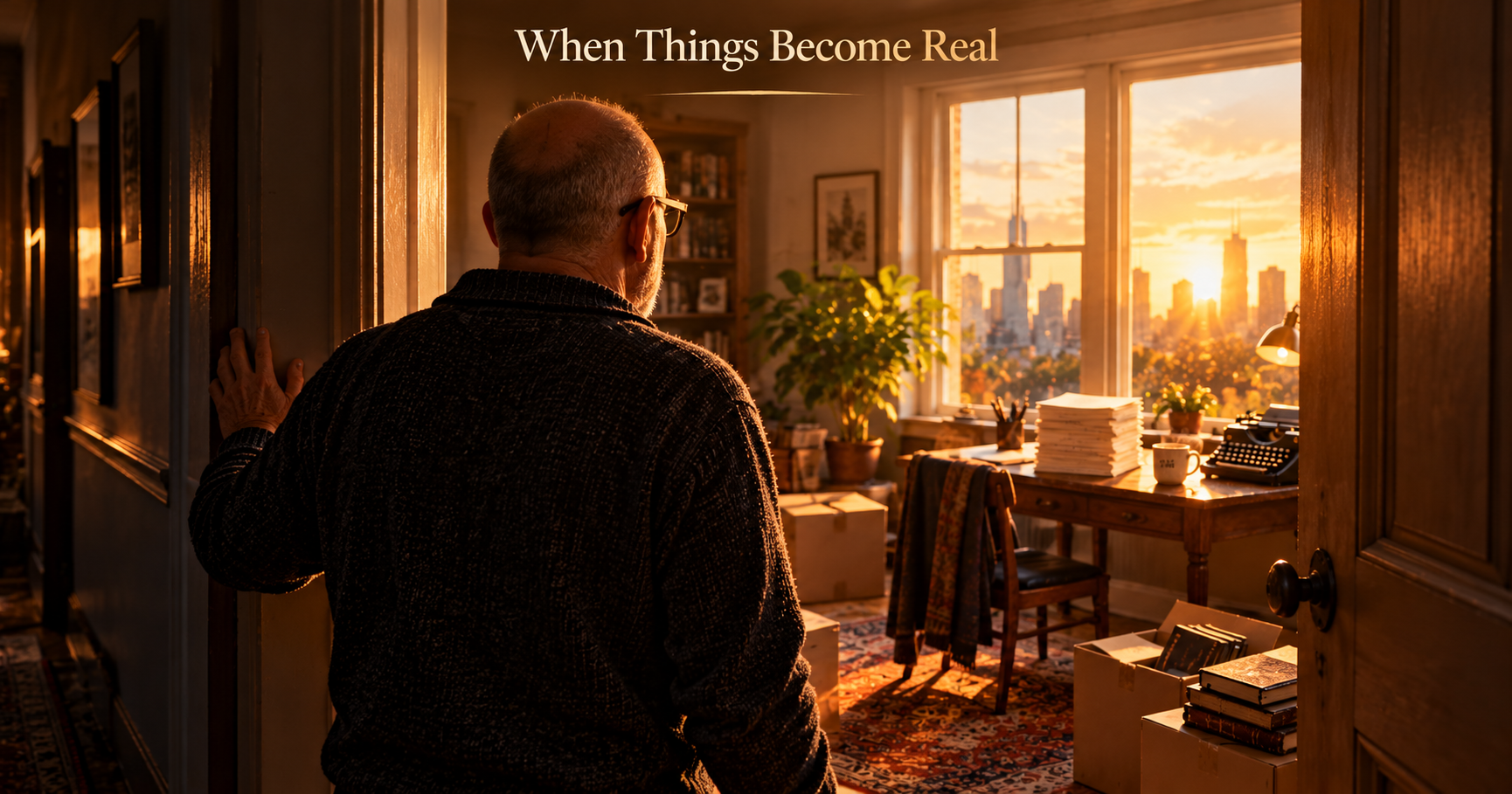
    Right now, it is a manuscript on my desk and a plan that finally fits it.

    Alignment Before Outcome

    You do not need everything figured out to move forward.

    You need enough clarity to take the next step.

    Something becomes real the moment you stop planning it and start stepping into it.

    If this resonated, pull up a chair. I send one letter a month with new writing and honest updates on my novel, Paul’s Penance. Sign up at danhansen.com.

  • What It Actually Took to Finish Paul’s Penance

    What It Actually Took to Finish Paul’s Penance

    Twenty-two years ago, I started writing a book called Paul’s Penance.

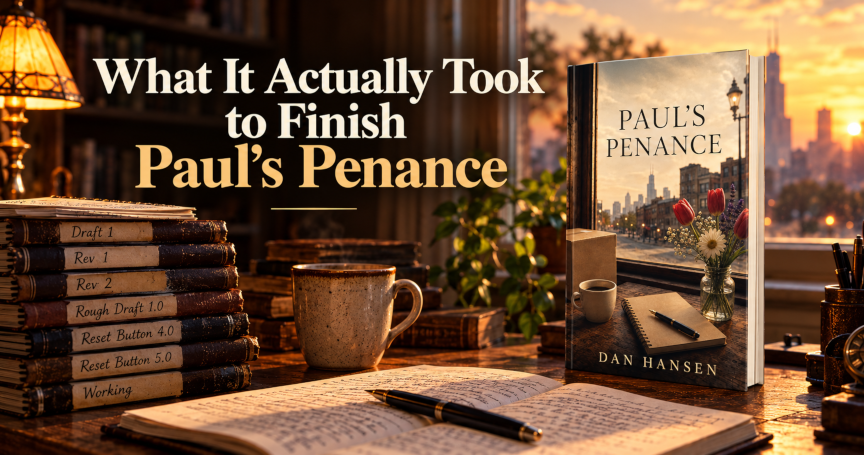
    Somewhere along the way, it became Reset Button. Then it became Paul’s Penance again. I have the folders to prove it: Draft 1, Rev 1, Rev 2, Rough Draft 1.0, Reset Button 4.0, Reset Button 5.0, and finally, just “Working,” like the file itself got tired of pretending it knew what it was called. Two titles trading places for over two decades, each one feeling like the right name at the time.

    I used to think that was the story: a guy who couldn’t make up his mind, circling the same manuscript for twenty-two years because something in it wasn’t working yet.

    I don’t think that’s the story anymore.

    Here’s what actually happened. I had to finish Alignment Before Outcome first. I had to get through cancer. I had to keep showing up for morning pages, day after day, long before I understood what any of that daily, unglamorous practice was actually for. None of those things were Paul’s Penance. All of them were, apparently, prerequisites for it.

    I don’t think I could have finished this book without finishing those other things first. Not because they taught me craft, though they did some of that, but because Paul’s Penance is a book about a man who’s given thirty days to face what he owes, and to whom. I couldn’t write my way to the end of that question from the outside. I had to actually go live some version of it. Cancer has a way of asking you what you owe and to whom in a tone that doesn’t accept a deflection. Morning pages have a way of making you sit with an unfinished thought until it finishes itself, whether you wanted it to or not.

    So the book waited. It changed its name twice while it waited. And it turns out that was never wasted time. It was the book refusing to be finished by a version of me that wasn’t ready to finish it honestly yet.

    I’m back to calling it Paul’s Penance now, and I don’t think that title is going to move again. I’m deep in revision, chapter by chapter, catching the places where the story still contradicts itself. And a few of those contradictions, it turns out, are the interesting ones. I’m finishing it at the pace it needs, not the pace a calendar wants.

    Twenty-two years is a long time to spend on one book. I used to be a little embarrassed by that number. I’m not anymore. It took exactly as long as it took to become someone who could actually finish it. I don’t think that’s a flaw in the process. I think that’s just what a book this personal costs.

    More updates soon. There’s a bigger one coming next week.

    If this resonated, pull up a chair. I send one letter a month with new writing and honest updates on my novel, Paul’s Penance. Sign up at danhansen.com.

  • Letting It Fall, Then Sorting It Clean

    Letting It Fall, Then Sorting It Clean

    There’s a version of surrender that sounds like letting go of everything.

    “Throw it up in the air and let God sort it out.”

    There’s truth in that. It points to trust. To releasing the need to control every outcome or prearrange every answer.

    But there’s another layer that becomes clear with time.

    Letting go doesn’t mean checking out.

    It doesn’t mean avoiding what’s in front of you or refusing to engage with what’s unfolding.

    It means releasing control while staying present.

    For me, that looks like writing things down instead of tossing them aside. Looking at what’s there instead of ignoring it. Sorting what falls, placing each thought where it belongs, not to force meaning, but to understand what’s already emerging.

    There’s a quiet distinction here that changes everything.

    Surrender allows life to move.

    Avoidance steps out of it.

    Both can look similar from the outside. Both can sound like letting go. But internally, they come from very different places.

    One is trust.
    The other is disengagement.

    What I’ve found is that real alignment sits between the two.
    Not controlling.
    Not abandoning.

    Participating.
    Trust what’s unfolding.
    And still show up with the pen in your hand.

    Alignment Before Outcome

    You don’t have to control the story to be responsible for how you show up inside it.

    Alignment isn’t passive.

    It’s participation without force.

    Surrender writes the story, but participation is how you hold the pen.